


If you want potential clients to invest part of their wedding budget with you, you already know you’re going to have to talk yourself up on your website.
But here’s the thing: literally anyone can whip up a gorgeous website and claim to be the best at what they do.
Clients are becoming increasingly skeptical as they hear horror stories online from other couples whose vendors didn’t live up to their portfolio. (Type the word “wedding” into Google News, and you’ll see countless stories of venues that abruptly closed and photographers that ghosted.)
You need something that backs up your claims—so both couples and potential creative partners will feel like they can trust the quality of your work.
What Is Social Proof?
In marketing, “social proof” is evidence that someone else—ideally, someone just like your ideal client—liked your product.
As humans, we’re constantly looking around to see what other people are doing, because we assume that if they’re doing it, it must be good. That’s especially true when it comes to buying. Maybe you ask your neighbor for their landscaper’s name because you like the way their yard looks. Or maybe you look up Michelin-starred restaurants for your trip to Italy, because if Michelin approves of it, it has to be good.
Your potential clients are looking for examples of social proof before they hire you for their wedding. And while they’re probably going to check your reviews on The Knot or ask about you in their local subreddit, you should have social proof on every single page of your website.
(Remember: the goal is always to get them to stay on your site—if they hop over to Google to check your reviews, it’s easy for them to get distracted, search for movie showtimes in their area and…boom, you’ve lost them.)
So let’s talk about the 5 types of social proof you should be collecting as a wedding vendor, and when and how to use them on your website.
5 Key Types of Social Proof for Wedding Pros
Testimonials from past clients
This is the gold standard of social proof—a past client explaining, in their own words, why they chose to book you, what their experience was like, and how it made them feel.

This is the epitome of “show, don’t tell.” You can and should talk about yourself, but it’s so powerful to hear from your clients. They pulled over the car to look at your photos—and then burst into tears? That speaks for itself.
A few things to consider when using testimonials on your website:
- Don’t put them all on a separate page. Instead, carefully choose the best ones and add 1 or 2 per page of copy.
- Try to match the testimonial to the service. So if you have separate pages for wedding design vs. florals, pull a testimonial from a client who’s booked that exact service. (If you’re launching something new and don’t have a testimonial yet, then go for one that talks about your client experience, or you as a person.)
- Don’t put testimonials in carousels. This is a hill I will die on. Every time I see someone do this, they’ve stuck some of the best stuff at the end, where people might never see it.
Also: edit your testimonials This is one of the most common mistakes I see when wedding vendors DIY their own website copy—they use long testimonials with a lot of filler.
Just because a client wrote a 300-word review does not mean that you need to use every word. Pluck out the relevant sentences. Be ruthless (just make sure your edits don’t change the meaning of what they said). Chop things up into shorter paragraphs, as in the example above, where the standout quote is in larger text.
“As seen in”
If you’re a wedding vendor, your work may have been featured in blogs like Style Me Pretty, print magazines like Brides, or on popular Instagram accounts like Over the Moon. By adding the logos of those publications to your site (especially on your homepage), you’re showing that you’ve received their stamp of approval, and you benefit from their good reputation.
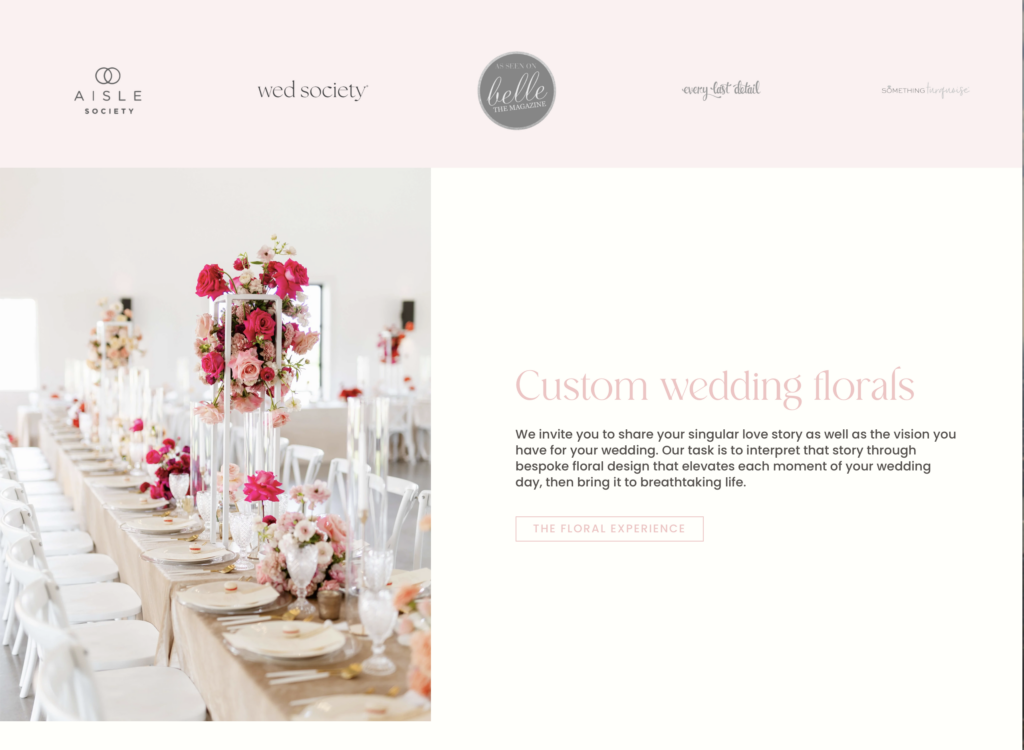
There are plenty of variations here—another popular option is an “As heard on” bar featuring the logos of podcasts you’ve spoken on, or logos of conferences where you’ve been a featured speaker.
I’ve also seen wedding industry educators and service providers specify where their clients have been seen. This is ideal if you can clearly point to how your efforts got them featured—like if you do PR or submissions on their behalf.
When using this kind of social proof, confirm that you have permission to feature a publication’s logo. Some publications, like The New York Times, charge a licensing fee to display their logo on your site. Vogue is also getting stricter, and you can no longer watermark photos with their logo.
Awards
If you’ve recently won an award, you’re going to want to make note of that on your website.
For example, if you’re a photographer and you were named one of Rangefinder’s 30 Rising Stars in the past year or two? You need that on your site.
Does it matter to every single client? Definitely not (sorry). But it may make a difference to someone.
That said, awards with a specific year are better when they’re fresher or show a streak (you’ve been named the top florist in your town for 5 years running). If you won a bunch of awards five years ago but nothing since, it may not send the right message to show them all.
By the numbers
Especially if you’ve been around for a while, this can be a fun way to showcase your expertise.
My favorite way to play with this is to choose 2 (or more) “hard” numbers, then throw in a final number that’s a little more fun, like so:
WE’VE PLANNED
51
WEDDINGS
AT
18
VENUES
AND BUSTLED
32
DRESSES ALONG THE WAY
(I like to think of this as the McDonald’s trick. On every sign, below the word “McDonald’s,” there’s a little line that says “Billions and Billions Served.” They’ve been showing their numbers since 1955. If it worked for them…)
Don’t be afraid to get specific, either, rather than rounding your numbers. Buyers love specifics – they seem more credible.
Adding specific numbers also helps with showing up in ChatGPT search results. AI search tools love to create tables so that users can compare and contrast businesses. If you list your years of experience or the number of weddings you’ve done, that’s a data point that AI can show a potential client.
Badges & memberships
Your clients see these as proof that you meet someone else’s standards, whether through formal training, membership in an organization, or by pledging to adhere to a certain set of values.
For example, if you’re an active member in industry organizations like WIPA or NACE, you should mention that on your site. This can also be a positive when other vendors are looking at your site to see if they should refer a client or a lead to you.
Elopement photographers often choose to display a Leave No Trace icon on their site, so that potential clients can see their commitment to the environment.
Likewise, many wedding businesses who’ve received Equally Wed Pro certification include the logo on their site so that LGBTQ+ clients know they’re an inclusive business. (And that they’ve literally put their money where their mouth is, in this case.)
How to Gather and Organize Social Proof
When it comes to testimonials, you should touch base with your clients shortly after their wedding to ask them a few questions. Notice that I didn’t say “leave you a review.” Yes, of course you want them to post reviews on Google and other platforms.
But when you send them a few questions in a form, you can guide them toward quotes that fill gaps in your social proof. Maybe everyone raves about your photos, but not enough people talk about your client experience.
Then you can ask them to transfer that information over to Google Reviews, The Knot, or any other platform where your clients find you. Make it easy—provide a link in your testimonial form.
For everything else, keep a nice little folder or Notion page where you can track awards, podcast episodes, memberships, and anything else you want your ideal clients to know about. (Your copywriter will love you for this, promise.)
Learned something? I’m thrilled to hear it.
If this was your jam, my newsletter Solicited Advice will be, too. Every Monday morning, I pop into your inbox with the answer to a reader’s question about marketing, websites, and the wedding industry as a whole. Sign yourself up here.


